Showing posts with label thrift. Show all posts

Wednesday, April 15, 2009

Cheese, glorious cheese!

I'm sure I've mentioned this before, but it bears repeating: we are serious cheese freaks. We LOVE cheese. We'd basically eat nothing but cheese if I didn't exert serious restraint and monitor our cheese consumption. Of course, living on the Vermont border, we have access to loads of amazing local cheeses, which we enjoy, but because we eat so much cheese, we also need a more utilitarian, run-of-the-mill, basic, everyday cheese. We call this "snack cheese" (as opposed to "special cheese" or "cooking cheese").


Lately our grocery store has been having amazing specials on cheese, bringing our standard snacking cheddar down to only $2.99 a pound, so of course we've been stocking up. With all that cheese on hand, however, the danger is that we'll go overboard and eat way too much cheese (yes, hard to believe, but there is such a thing). So we've rationed it. I figure that between the two of us, one 8-oz bar of cheddar per week is sufficient (especially since that's not the only cheese we eat - that's just for simple snacks). When the price drops this low, the limit is six bars at a time, so in theory, the supply should last six weeks.

We've done shockingly well with this allotment, even having some bars of cheese last longer than a week. The timing also works out well because it seems like Price Chopper runs this special around every six weeks - so right as we're running out, we can stock up again. Perfect.

When we lived in London, there was a greater variety of cheap cheeses in the supermarkets there, and we enjoyed trying out as many different kinds as possible. I especially liked to toss some Red Leicester in my mac and cheese, and we enjoyed Stilton with apricots on oat cakes. Mmmm, yummy! And of course the cheddar was great - more sharp aLinknd crumbly than supermarket cheddar here. Hard to believe it's been four years since we moved back!

What are your favorite cheeses? Anything we should try? I'm thinking a cheese taste-test series on the blog would be an excellent excuse to buy more cheese!

Wednesday, March 11, 2009

I yam what I yam...

... and that's a lady who loves her spinach. Baby spinach, especially. Fresh, local, organic baby spinach for the first time in months! This salad was amazing - just spinach, a shredded carrot, and some sprouts with a very lemony dressing (lemon juice + salt + EVOO). I had some last night with homemade cheese pizza (this dough recipe is still amazing - I made another quadruple batch yesterday and froze three extra balls).


I buy shredded mozzarella in a big two-pound bag for $7.99. Two pounds yields approximately eight cups, which is enough for at least eight pizzas, depending on how cheesy I'm feeling. I use tomato puree (one 28oz can has enough for at least twelve pizzas) and I buy the flour and yeast for the dough from the Coop bulk bins, so pizza is a very cheap meal (and if you go easy on the cheese, it's pretty healthy paired with a salad). Each pizza provides dinner and lunch the next day for the two of us, so I'd wager it comes out to less than fifty cents per serving. Even when we have to buy lettuce from the grocery store, I'm pretty sure pizza and a salad comes out to around $1.00 per serving. Definitely thrifty, tasty, and easy!

Thursday, February 19, 2009

Food Budgeting

Yesterday I mentioned that I had budgeted $10 for nice cheese for Valentine's Day. It's been at least two years since I've done any formal food budgeting - I usually just keep a rough estimate in my head and try not to go over a target - but since we're really trying to save money, I decided to try a new and very formal budget. At the beginning of the month, I sat down and wrote out a list of all the food I thought we might need to buy in February. I then assigned a dollar amount to each category; for example, I budgeted $15 for salad greens for the month. I gave us a little leeway with an "other" category that would bring the total for the month to $200. It's not an extremely thrifty amount for two people, but for the first month, I wanted to make sure the goal was realistic.


I then put the whole list in Excel, as shown above. (The graphic shows a total of $155 because we had already spent $45 stocking up on February 1st.) Whenever I buy food, I save the receipt and enter the amount in each category. The column on the right shows me whether or not I've gone over budget for that item. You can see that my estimates were not perfect. Because of Dan's birthday and Valentine's Day this month, there were some more extravagant purchases than usual. Also, because of a food challenge I'm doing (more on that tomorrow), I'll definitely go over budget in the "other" category. However, I'm pretty sure that I'll be able to stay within the overall budget and not go over $155/200.

Having a strict budget like this has been helpful for me because I'm less likely to toss random things (like, say, kalamata olives) in to the cart if I know I'll have to account for them later. You may have noticed that there is no meat on the list; that's because I fill the freezer when I find a good deal and such purchases usually last for a long time, since we don't eat much meat anyway. I think the only meat I bought this month was two slices of deli ham (accounted for under "other") for a macaroni dish we had a couple of weeks ago. We've had chicken a few times, using frozen breasts that I bought in bulk. Mostly, however, we get our protein from beans, cheese, or nuts.

What's not in this budget? Household items like cleaning supplies - we haven't needed to buy any this month. Personal care items - I did buy a toothbrush this month, but that's it. I didn't include personal care as a category in the budget because we spend so little on stuff like that anyway. We buy the cheapest shampoo and we stock up on things like shaving cream and soap when they are on sale, so we only have to restock every few months. We also buy toilet paper and tissues in bulk, and it's not like we could cut back on that sort of thing, anyway. Really, I built the budget around food because a) we already spend minimally on non-food groceries and b) food is where we can easily spend in excess; if we aren't careful, we can add $100 or more to our monthly bill by tossing stuff like crackers, wine, and cantaloupe in to the cart.

The list above clearly does not include everything that we are eating this month; it's just everything we are buying. We won't eat all of it (for example, the tomatoes and lentils should last us at least another month) and what we do eat will be supplemented by food we already have on hand. Our CSA provides us with all the root vegetables we could ever hope to eat and we also have a lot of frozen vegetables and fruit (put aside last summer or bought in bulk on sale).

I've started the list for March:
  • milk
  • cheese
  • butter
  • yogurt
  • eggs
  • salad greens
  • frozen broccoli
  • canned fruit
  • dried cranberries
  • flour
  • yeast
  • oatmeal
  • nuts
  • whole chicken
  • turkey sausage
  • 12 pack beer
So far I've budgeted $115 for the items above. I'm trying to think if there's anything else I will need. If this is it, I'll add an "other" category for $35 and see if I can try to keep all food costs in March down to $150.

Tuesday, February 10, 2009

Food News Roundup

With the economy as it is, thrifty eating is a hot topic and I come across articles about it every day. Here are a few links that you might find interesting:

--The "food stamp challenge" has been done by bloggers, journalists, and politicians before; CNN's Sean Callebs is doing it this month and is documenting his experience on the "Living on Food Stamps" blog. (Side note: "food stamps" is an outdated phrase, but one we are all used to; the program is now called Supplementary Nutrition Assistance Program - SNAP - and uses debit cards, not stamps.) Callebs is going with the budget of $176 per month, the maximum a single person can qualify for where he lives. It's interesting and worth a read; I'll be following it throughout.

--This is old news, but Rebecca Blood (whose lentils and rice recipe I've referenced multiple times) spent a month eating according to the USDA's Thrifty Food Plan (on which SNAP allotments are based). That works out to $320.80 per month for Rebecca and her husband. But Rebecca added a twist: she wanted to continue eating primarily local and organic, and she insisted on a daily glass of wine with dinner. Start here and follow her journey through one month of thrifty eating; it's fascinating and inspiring.

--If you read her intro post, you'll see that Rebecca acknowledges that she has some advantages in eating thrifty: she's educated about nutrition, she has time to prepare food from scratch, and she has access to fresh and local goods. This article from a USDA report on the economics of food discusses some of the challenges that low-income Americans face in eating balanced, healthy diets.

--Speaking of access, a group of farmers and sustainability groups are banding together to increase access to locally-grown foods in my home state of Maine. Plans include cooperative storage space, a website for easy ordering, and a GPS-guided delivery system. They hope to have it all ready to go next year.

Thursday, January 29, 2009

End-of-the-Month Soup

My camera battery is dead and the charger has disappeared, so the picture for this post is currently trapped on the camera. I'll upload it as soon as I can.

ETA: Woohoo! Charger recovered, battery charged, picture posted!


You may have noticed that I skipped the Salad Days post yesterday. It wasn't an oversight, and I'm not canceling the Salad Days series. In fact, I didn't do a salad entree this week for a very simple reason: we had run out of fresh greens, but we still had plenty of other ingredients on hand, and since it's the end of the month and I wanted to stick to our January budget, I decided not to buy more salad greens this week. So, no salad entree. Instead, I made a simple vegetable-bean soup. The carrots that we got at the beginning of the month from our winter CSA had gone a bit soft, so they weren't great for crunching raw, but they would work just fine in a soup. Ditto for the celery we bought a couple of weeks ago. These withering vegetables made the basis for a tasty, satisfying, and very cheap meal. I served it with some homemade focaccia - a first for me, and since I'm not fully satisfied with that recipe yet, I'm not posting it here.

End-of-the-Month Soup

2 teaspoons olive oil
1 medium-size onion or 3-4 shallots
3-4 cloves garlic
3-4 carrots, chopped
4 stalks celery, chopped
4 small potatoes, diced
2 cups cooked chickpeas (frozen or canned okay)
28oz can tomatoes (whole or diced)
broth, any flavor (optional)
2 teaspoons Italian herb blend
salt and pepper to taste

Heat the oil over medium-low heat in a large soup pot. Add the onions and garlic and cook until onions are translucent. Add the carrots and celery and cook, stirring occasionally, for another 3-5 minutes. Add potatoes, chickpeas, tomatoes, and spices. Fill the now-empty tomato can with water and add the water to the pot. You can substitute stock for some or all of the water. I used some water, plus a small wedge of frozen concentrated turkey stock that I made with Thanksgiving leftovers. Bring to a boil, then reduce heat and simmer, covered, until potatoes are tender.

This is just a very basic bean and veggie soup and you can easily substitute whatever you have on hand. This would be great with fresh or frozen broccoli, cauliflower, and corn, too. I used chickpeas straight from the freezer, but you could also us canned chickpeas or any other kind of bean (black, kidney, etc.).

A note on carrots: if your carrots are organic, or if you're not concerned about pesticides, don't peel them first - just scrub them well. The carrot skin has a lot of great fiber in it that gets lost when you peel. The same goes for the potatoes.

Also, a note on canned tomatoes: yesterday I said that canned vegetables aren't the best and today I'm writing up a recipe with canned tomatoes in it. What gives? Well, tomatoes are rare in that their nutritional content actually improves in the canning process. Tomatoes are rich in lycopene, an antioxidant which is less available to us in raw tomatoes. Heat helps break down the cell walls and release more lycopene, so canned or cooked tomatoes actually offer more benefits than raw ones.

Wednesday, January 28, 2009

Freezing!

Outside, that is. It's about 15 degrees Fahrenheit as I type. Of course, that's thirty or forty degrees warmer than the worst temperatures we had a few weeks ago. But still, it's cold, and I'm happy to be inside and comfortable. The freezing weather outside has inspired me to write about freezing inside - that is, freezing vegetables for later use.

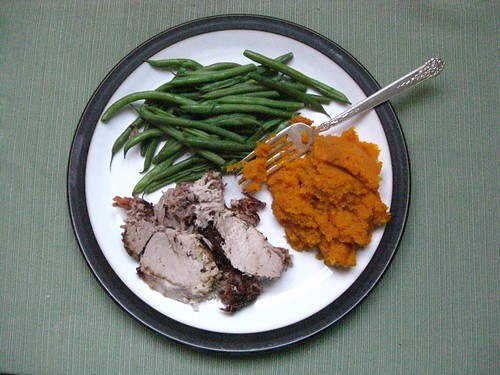
This was a delicious meal - roast pork loin with sage rub, roasted butternut squash with cinnamon and butter, and French green beans. Thanks to the freezer, this meal was actually made on quite short notice and with little effort.


The pork loin, which was not frozen, did take some time to roast, but it was hands-off time so I could be productive elsewhere. The sage rub I used was actually a prepared seasoning mix, something I found in my cupboard and thought, "Why do I have this? I don't remember buying this. Oh well, might as well use it!"

Both side dishes came from the freezer. I had roasted, mashed, and frozen the squash from our winter CSA weeks before, so all I had to do was pull it out to thaw when I put the roast in and then put it in the oven to warm up during the last twenty minutes or so of roasting time. The green beans were originally from a summer CSA box. When they arrived, I knew we wouldn't use them that week, so instead I washed, trimmed, and froze them raw; when I wanted to use them, the frozen beans went right in to the steamer basket and cooked for about seven minutes.

The freezer is particularly essential for me in winter when I can't get fresh vegetables locally. Freezing the excess from the abundance of my summer CSA share means that food doesn't go to waste. I also buy a lot of frozen veggies from the grocery store. Most of these veggies are now flash-frozen right after harvesting, so they actually retain more nutritional value than the "fresh" produce that is shipped thousands of miles. Frozen vegetables are also better than canned because canned vegetables often have a lot of added sodium and the heat from the canning processes destroys some nutrients. Plus, frozen veggies are cheap: I stock up at my local PriceChopper when they go on sale for $1.00 or $1.50 for a two-pound bag, but even at the normal price, they cost about $1.00 per pound.

What's your favorite frozen vegetable? I just love having the little packets of mashed roasted squash on hand; also, lately I can't get enough broccoli!

Tuesday, January 27, 2009

Stashbusting

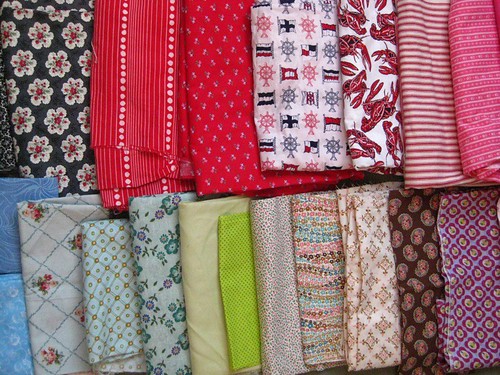
When I said the word "stashbusting," my husband yelled, "WHAT?!" and quickly covered his face. You see, he heard "'stache busting" and assumed I was going after his beloved handlebar mustache. I have no such intentions; I actually love his 'stache, as it perfectly expresses his quirkitude. No, the stash I intend to bust is my fabric stash. This weekend I pulled it all out of storage so I could take inventory and actually, you know, use it. Well, it turns out I have amassed over 100 yards (!) of fabric, most of it in lengths of two yards or less.

Some of my 34 different quilting fabrics.

I'm not going to turn Choice of Pies into a sewing blog, but I did want to let you know of my plans. I created a monthly calendar with two or three sewing projects listed next to each month; if I can keep up with this schedule, a good portion of my stash should be obliterated by August. Pictures of all the fabrics are in my Stashbusting 2009 Flickr set, and I will add pictures of the projects (which include a hoodie, five dresses, two blouses, two aprons, and more) as they are completed.

I also have some pantry stashbusting planned; I recently reorganized and realized I have seven different kinds of rice (wild, jasmine, sushi, brown basmati, brown nishiki, long-grain brown, and arborio) and six kinds of dried beans (chick peas, lentils, adzuki, pink, small white, and rattlesnake) just waiting to be used, so I'm probably going to do a lot of variations of rice and beans in the comings week. Clearly I have some packrat tendencies. There's nothing wrong with having so many different kinds of rice and beans on hand - each serves its own purpose, and long-term storage isn't a problem - but it's been a while since I've tried to do anything different with these humble and nutritious ingredients. Best of all, they are all cheap, and even cheaper (free) since I already have them on hand. I anticipate lower grocery costs in February while I shop from my own pantry.

Thursday, January 8, 2009

Sorta-Stuffed Squash

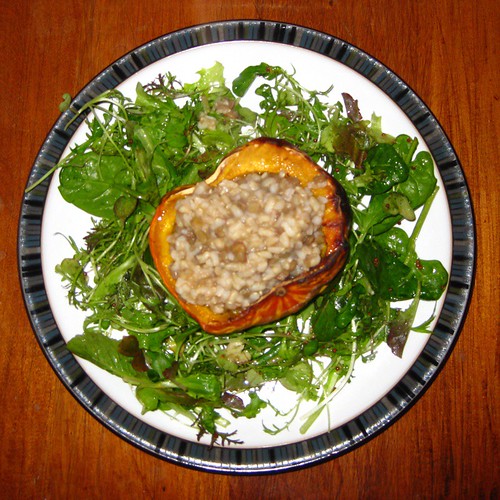
Here's the stuffed squash post I mentioned last Friday. I call it Sorta-Stuffed Squash because every stuffed squash recipe I've ever seen involves stuffing the squash and then baking it. Sometimes the squash is partially baked first, but it always ends up in the oven after being stuffed with some sort of mixture, usually rice-based. This recipe cheats by cooking the filling separately from the squash and just throwing them together at the end.

You might think cooking the squash and the filling separately is more complicated, but both steps are actually very easy and totally hands-off once you've got them on the heat. After halving the squash and scooping out the seeds, put a pat of butter in the hollow of each half and roast them, cut side up, for about 35 minutes at 400 degrees. The exact time will vary from squash to squash, but they should be tender when you stick a fork in them.


Once the squash is in the oven, make Rebecca Blood's brown rice and lentil recipe, which I've mentioned before. It couldn't be simpler - just lentils, rice, and water - then add salt and/or a little red wine vinegar when it's done. The lentils take about 25-30 minutes to cook, so your squash and your lentils will be done around the same time. Meanwhile, rinse and spin your lettuce, make your dressing, and you've still got twenty minutes to check email, watch the news, or - my favorite - enjoy a glass of wine.

When both the squash and the lentils are ready, scoop the lentils into the squash hollow. Tada! You're done. The rice and lentils absorb some of the melted butter from the squash, and the sweetness of the roasted squash nicely complements the salted, earthy taste of the lentils. This meal is a hat trick: easy, healthy, and cheap.

Thursday, October 9, 2008

Why We Chose a CSA

It's good for our budget. We elected both summer and winter CSAs; the summer season goes from June through October, while winter spreads from November to May. When we signed up last spring, then, we essentially pre-purchased a year's worth of vegetables. The total for both seasons came to about $500 -- this breaks down to less than $10 a week. A look at any of our weekly portions shows that we are getting a good deal here; the equivalent amount of fresh produce from our local Price Chopper would unquestionably cost quite a bit more, even if we bought the less-expensive non-organic vegetables.

It's good for our health. We selected an organic farm for our CSA; many, though not all, farms that offer CSAs follow organic practices. Among other things, organic means they don't use any chemical pesticides, so we don't have to worry about ingesting them. Also, because they don't travel as far, we receive the veggies much sooner after they are harvested. Typical grocery-store produce travels an average of two to three weeks before it is even sold. Since the nutritional value starts to decline immediately upon harvest, the sooner the produce is eaten, the better it is for your body.

Our CSA also offers a third health benefit: because we receive such a bounty each week, our vegetable consumption has gone up. While I would always buy vegetables when I went to the grocery store before, I rarely bought enough. It's too easy to get distracted by things like cereal or boxed mac and cheese. Now, every Friday, there's a boxful of veggies in our kitchen, and we are forced to consume them - or deal with the guilt of letting good veggies go to waste. Most of the time, we successfully consume (or preserve) the whole load.

It's good for our taste buds. Because these vegetables have a shorter and quicker trip from farm to table, they are fresher and more flavorful when we consume them. Also, much of the produce available in grocery stores is of varieties that are bred for durability and uniformity rather than taste. Because the veggies don't have to travel so far, our farmer can grow heirloom varieties that offer richer and more complex flavors.

It's good for our community. CSAs help farmers because they get some guaranteed income early in the year during a period when most aren't able to sell much produce. By signing up during the off-season, we provide farmers with a much-needed cash-flow injection at the hardest time of the year. They can then use the money from CSA subscriptions to buy seeds for the new crops. It also helps them judge how much to plant, because they know how much they need to produce to satisfy the CSA subscriptions.

Keeping small, family-run farms going is important to me because I appreciate the rural qualities of the area I live in. I like driving by farmland, seeing productive fields, and knowing that there are lots of places very nearby where I can go to pick berries or apples. I also like that most of my food is coming from fellow community members rather than from an enormous, impersonal, factory-style organization thousands of miles away. CSAs help farmers, but as I made clear above, CSA subscribers also benefit enormously from the relationship. This is not charity; it's good old-fashioned commerce, working in such a way that it benefits all parties involved - just as it should.

It's good for the environment. Organic farms don't use synthetic pesticides, which run off in to our rivers and seep in to our groundwater. Most small farms also rely on old-fashioned practices to keep soil productive. Rather than planting the same crop over and over on the same space, which can leech the soil of its nutrients, small farmers, who have to make the most of their limited land to survive, often practice crop rotation that allows the soil to stay productive. This means they are getting the best use out of the land.

Also, because CSAs are local in nature, they help to conserve our energy resources. Much of the produce in grocery stores has been transported thousands of miles, either by boat or truck. That requires vast amounts of oil and gasoline. Buying locally ensures that these limited resources aren't wasted. When we went to North Carolina this summer, I was flabbergasted to see only California peaches for sale. Why would you ship something from three thousand miles away when the same product was growing all around? A few days later, we made it to a nearby farmers' market, where to my delight, we found fresh North Carolina peaches. They were twice the size of the grocery-store peaches, packed with twenty times the flavor, and hadn't wasted valuable resources in getting to us.

So there you have it: my many reasons for CSA participation. There are a few downsides, which I will address in another post, but they are far, far outweighed by the benefits.