Showing posts with label csa. Show all posts

Tuesday, March 10, 2009

Winter CSA - March

Here's the March share that we picked up a few days ago. Notice anything... unusual?


That's right! GREENS!!! That's a bag of fresh baby spinach in the top left. Thank goodness for greenhouses (the ground's still frozen here). There's also a bag of alfalfa-radish sprouts, which have a slightly spicy bite. Other than that, we've got the winter usual - potatoes, carrots, daikon, celeriac, beets, and rutabagas. A few of the potatoes are huge, so I'm thinking they are good candidates for baking. Maybe we'll top them with some veggie chili.

Does anyone have any rutabaga recipes to share? I'd like to try something a bit different with these. I'll use most of the carrots, celeriac, and beets to make more of that amazing shredded salad, and I'm toying with a few different options for the daikon.

Monday, February 9, 2009

Winter CSA - February

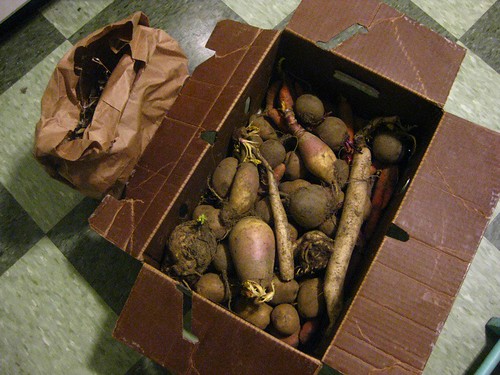
No pretty produce shots this time. I haven't had time yet to scrub and sort the veggies, and I wanted to take a picture before we start using it up (in fact, I grabbed a beet and a carrot for tonight's salad immediately after taking this pic). Plus, a more rustic view might be good for a change. After all, this is how we receive it: tumbled together and covered with dirt. The summer deliveries are usually cleaner but the winter veggies are stored in dirt-filled bins at the farm.


I mentioned recently that it's time to sign up for 2009 CSAs. This goes for most winter CSAs as well. While we are certainly signing up for another summer share, we've decided to pass on the winter share. The first month was amazing, but the rest of them have been like this (only with cabbage). We haven't made the best use of our share and have thrown out more gone-by produce than I care to admit. The sad fact is, I just can't handle so many root vegetables. (My Scandinavian and Irish ancestors are now rolling over in their graves.)

Where we live, nothing else is available locally in the winter, so other than the fresh lettuce for our salads and the occasionally indulgence of imported fruit, we've been relying on frozen vegetables. Some are summer share surplus that we froze for exactly this purpose; others are bags that we've purchased at our local grocery store. Frozen seems to work well for us. While I feel bad about the food we've wasted from the winter CSA, we've learned an important lesson - a winter CSA is just not for us. (Now, I'd be singing a different tune if we lived in say, California, and a winter share included fresh citrus and greens - but alas, we live in a land of thrice-weekly blizzards.)

So the plan for this year is to sign up for our summer share - once again, a small share from Luna Bleu Farm - and to take the money that would go for a winter share and designate it for farmer's market purchases. That way, when our favorites like kale and spinach are in abundance, we can buy a lot and immediately freeze it for winter use.

Friday, January 30, 2009

Get Ready for Summer!

Despite what you might think from the headline, I haven't lost it yet. Even though it's still January and we're being regaled with another six inches of snow two or three times a week, it's time to think about summer CSA sign-ups. The first deadline for the CSA that we use, at Luna Bleu Farm, is March 1, and Suzanne expects it to be full by then (so no late sign-ups).

My mom recently said to me, "Your CSA looks really great, but I don't think they have any near me." They do - in fact, there are more than twenty to choose from in her area. The Local Harvest CSA finder lets you search by zip code or by city and state. Unless you live in an extraordinarily dry, mountainous, or remote area, there is probably a CSA near you. Even then, it's worth a shot - Local Harvest's map shows CSAs in all 48 continental states. You can also try Eatwellguide.org's search - their CSA listings aren't as extensive, but they do have listings for Canada. If you're abroad, try Googling your country or region and CSA or whatever it may be called where you live. For example, in Britain, CSAs are usually referred to as "veg box schemes." If you're not sure, try searching "farm share" or looking at the website for your country's department of agriculture. The USDA website lists a few other CSA finders beside the ones that I mentioned, plus some more great links about CSAs.

And before you settle on a CSA, take the time to investigate your options. Not all CSAs are the same. Some require volunteer time on the farm (ours doesn't, but they do host occasional harvest days/potluck parties). Some have weekly drop-offs or pick-ups, some biweekly. Some require you to come to the farm, others offer pickups at central locations, and some even deliver to your door. There are CSAs where you choose nothing (all box contents determined by the farmer) and others that are more like discount programs at farm stands, where, for instance, you pay $200 in advance and in return you get $250 in credit to buy whatever you want. Some CSAs include things like herbs, fresh flowers, meat, bread, honey, milk, or eggs. There are so many variations, and chances are, whether you know it or not, you probably have options in your area.

If you decide to sign up for a CSA near you, PLEASE comment here and tell me what you've found! I'm really curious to know what you've chosen and why.

Monday, January 12, 2009

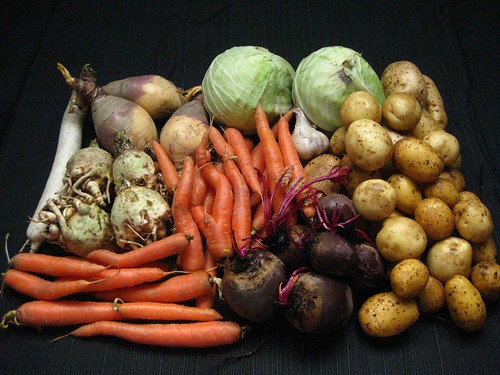
Here it is! Winter CSA, Month 3

We picked up our January share at the monthly indoor winter farmer's market in Norwich, VT. It's nice that it continues through the winter, but it's not nearly as interesting as the weekly summer market. In winter, we basically go just to get our share (and maybe a scone and a cup of coffee for the road). We're in and out in fifteen minutes, tops. At the summer market, however, there's so much more to look at and there is usually live music, as long as the weather is good. We like to take our time, check out all the booths, and do a few laps.


Anyway, January's share is not too bad. No more parsnips (woohoo!). The rundown:

-two cabbages
-four rutabagas
-four celeriacs
-six beets of varying size
-one enormous daikon radish (it must be at least 15" long!)
-about four or five pounds of carrots
-about five pounds of potatoes, some small (great for roasting) and some large (great for baking)
-one random bulb of garlic thrown in at the last minute

We also purchased some fingerling potatoes. Yes, five pounds of potatoes is plenty for the two of us for a month, but I just can't resist those wonderful fingerlings. I toss them with olive oil, salt, pepper, and herbs, and roast them until the skin is golden and crackling and the flesh is meltingly soft.

I think this is a good assortment. I'm working on a new carrot soup recipe, and the daikon will come in handy when I make something from one of my Japanese cookbooks (per my resolution). We used to eat rutabagas a lot when we lived in London, although we didn't know it at the time: the Brits call them "swede," and we used to get this pre-chopped carrot & swede blend that we could steam or roast. I'll have to do a little research on new (to me) ways to prepare them. I'm also looking for new beet recipes; I usually roast them, but the antioxidant levels drop when exposed to heat, so I'd like to add some raw beet recipes to my arsenal.

Anyone have any good root vegetable recipes to share?


Friday, January 9, 2009

Winter CSA, Month 1

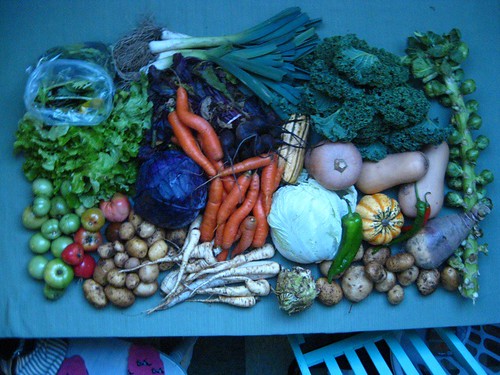
I have been remiss in posting pictures of our winter share. This is a shot of the first winter share, which we picked up in early November:


Pretty incredible, isn't it? And yes, those are my pink-stockinged feet in the corner. I had to stand on a chair in order to get far enough away to get everything in frame. And this isn't actually everything: we also had a huge bag of onions, shallots, and garlic bulbs (to last throughout the winter), a bunch of dried rattlesnake beans, still in the pods, and as much basil as we could pick.

The basil was turned into pesto and frozen in cubes; likewise, I roasted most of the squash and steamed all of the kale to freeze for future use. I have a few pictures of meals made from this harvest, which I will post eventually. A lot of my pictures from this time did not turn out very well. The days were getting shorter and the light more elusive, and by mid-November, it was usually dark out before I even started cooking dinner.

What about month 2, which we picked up in early December? Well, I never photographed it. As I mentioned, I kept getting sick, and I was very busy, and frankly, what we got in month 2 was just not as pretty. Think parsnips. Lots and lots of parsnips. Plus carrots, potatoes, and more cabbage than I will ever know what to do with. We still have some cabbage in the fridge, and we're going to pick up month 3 tomorrow!

Check back Monday for a picture of tomorrow's haul, and have a wonderful weekend.

Tuesday, November 18, 2008

Out of the Box: Final Week of the Summer


Our CSA "summer" share actually lasted well in to October. Here's a shot of our final weekly pickup, which included potatoes, beets, celeriac, leeks, rainbow chard, dinosaur kale, cabbage, carrots, butternut squash, delicata squash, broccoli, and brussels sprouts.

Both the butternut squash and the kale I cooked and then froze for later use. Everything else I used in various dishes that I will post about over the next week or so, except for the celeriac, which I still haven't used! Luckily it's a root vegetable and keeps very well.

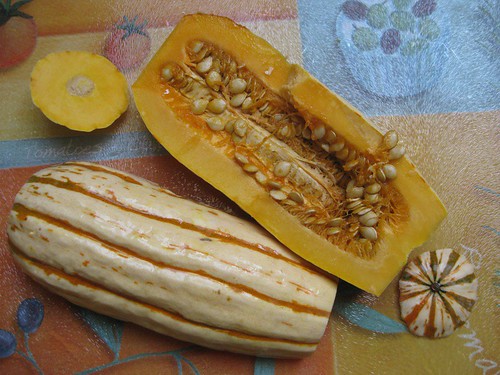
Here's the delicata squash after I sliced off the ends and cut it lengthwise, but before I scooped out the seeds. We received delicatas several times over the summer; the first time, I roasted the two squash halves with some water in the pan, and the result was indeed very delicate, with the texture of a very soft puree and a taste reminiscent of apples and pears. I also tried a delicata and gruyere soup, which was a huge disappointment: it was somehow too bland and too sweet at the same time (to me, anyway; Dan enjoyed it, but he's easy to please).

With this delicata, I think I finally found a method that really brings out the best flavor of the squash. I left the skin on and chopped the squash in to small chunks, which I tossed with olive oil, salt, and pepper, and roasted at 400 degrees for about twenty-five minutes, stirring once or twice. The result was amazing: the flesh was tender, the skin crispy, and the salt and pepper provided a nice, kicky contrast to the natural sweetness of the squash.


I tossed the warm, roasted squash cubes with dried cranberries and toasted pine nuts and added a simple side salad with mustard vinaigrette. This was a very satisfying and delicious meal, and the leftovers were not leftover for long; Dan couldn't pass through the kitchen without grabbing a few more bites, and I certainly couldn't blame him.


Thursday, November 6, 2008

Update: Roasted Vegetable Soup

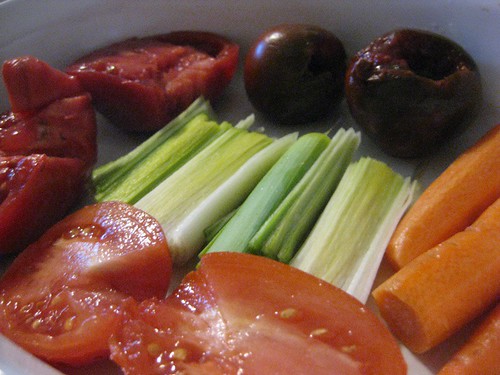
I found a few more pictures of the roasted vegetable soup that I posted about the other day. Here's a shot of the tomatoes, leeks, and carrots in the lightly-oiled pan, about to go in the oven:


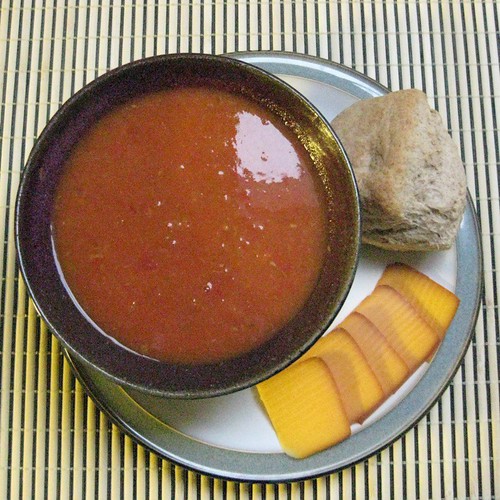
And here's a shot of the finished product, served with smoked cheddar and a whole wheat biscuit. This makes a wonderful meal for the cold, drizzly, late-fall days.


Friday, October 31, 2008

Roasted Vegetable Soup

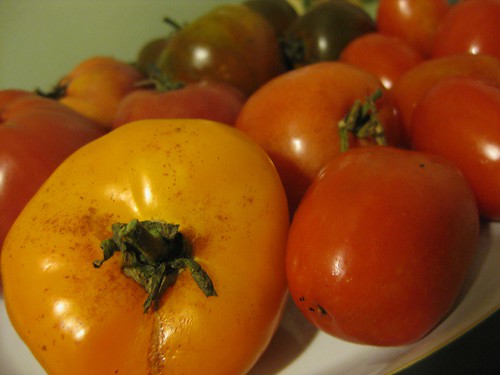
One of the best things about our CSA boxes this summer was the amazing array of heirloom tomatoes that came in August and September. My husband, Dan, is crazy about tomatoes, so most of them were eaten raw. As the weather started to cool, however, I wanted to try something a little different. I came across this roasted vegetable soup recipe while searching for a use for fennel and decided to give it shot. The method is incredibly simple and could work for almost any combination of vegetables. Basically, you roast the vegetables until soft, then puree them with some stock or broth and heat before serving. The first time I made it, I used leeks, carrots, and tomatoes, and the result was spectacular. Roasting the vegetables, rather than just boiling them, adds an incredible depth of flavor to a very simple dish. This recipe inspired me to create a new pasta sauce, which I'll describe in another post. I've since made the soup a few more times with different combinations, and it's sure to be a go-to recipe for me in the future.


Thursday, October 9, 2008

Why We Chose a CSA

It's good for our budget. We elected both summer and winter CSAs; the summer season goes from June through October, while winter spreads from November to May. When we signed up last spring, then, we essentially pre-purchased a year's worth of vegetables. The total for both seasons came to about $500 -- this breaks down to less than $10 a week. A look at any of our weekly portions shows that we are getting a good deal here; the equivalent amount of fresh produce from our local Price Chopper would unquestionably cost quite a bit more, even if we bought the less-expensive non-organic vegetables.

It's good for our health. We selected an organic farm for our CSA; many, though not all, farms that offer CSAs follow organic practices. Among other things, organic means they don't use any chemical pesticides, so we don't have to worry about ingesting them. Also, because they don't travel as far, we receive the veggies much sooner after they are harvested. Typical grocery-store produce travels an average of two to three weeks before it is even sold. Since the nutritional value starts to decline immediately upon harvest, the sooner the produce is eaten, the better it is for your body.

Our CSA also offers a third health benefit: because we receive such a bounty each week, our vegetable consumption has gone up. While I would always buy vegetables when I went to the grocery store before, I rarely bought enough. It's too easy to get distracted by things like cereal or boxed mac and cheese. Now, every Friday, there's a boxful of veggies in our kitchen, and we are forced to consume them - or deal with the guilt of letting good veggies go to waste. Most of the time, we successfully consume (or preserve) the whole load.

It's good for our taste buds. Because these vegetables have a shorter and quicker trip from farm to table, they are fresher and more flavorful when we consume them. Also, much of the produce available in grocery stores is of varieties that are bred for durability and uniformity rather than taste. Because the veggies don't have to travel so far, our farmer can grow heirloom varieties that offer richer and more complex flavors.

It's good for our community. CSAs help farmers because they get some guaranteed income early in the year during a period when most aren't able to sell much produce. By signing up during the off-season, we provide farmers with a much-needed cash-flow injection at the hardest time of the year. They can then use the money from CSA subscriptions to buy seeds for the new crops. It also helps them judge how much to plant, because they know how much they need to produce to satisfy the CSA subscriptions.

Keeping small, family-run farms going is important to me because I appreciate the rural qualities of the area I live in. I like driving by farmland, seeing productive fields, and knowing that there are lots of places very nearby where I can go to pick berries or apples. I also like that most of my food is coming from fellow community members rather than from an enormous, impersonal, factory-style organization thousands of miles away. CSAs help farmers, but as I made clear above, CSA subscribers also benefit enormously from the relationship. This is not charity; it's good old-fashioned commerce, working in such a way that it benefits all parties involved - just as it should.

It's good for the environment. Organic farms don't use synthetic pesticides, which run off in to our rivers and seep in to our groundwater. Most small farms also rely on old-fashioned practices to keep soil productive. Rather than planting the same crop over and over on the same space, which can leech the soil of its nutrients, small farmers, who have to make the most of their limited land to survive, often practice crop rotation that allows the soil to stay productive. This means they are getting the best use out of the land.

Also, because CSAs are local in nature, they help to conserve our energy resources. Much of the produce in grocery stores has been transported thousands of miles, either by boat or truck. That requires vast amounts of oil and gasoline. Buying locally ensures that these limited resources aren't wasted. When we went to North Carolina this summer, I was flabbergasted to see only California peaches for sale. Why would you ship something from three thousand miles away when the same product was growing all around? A few days later, we made it to a nearby farmers' market, where to my delight, we found fresh North Carolina peaches. They were twice the size of the grocery-store peaches, packed with twenty times the flavor, and hadn't wasted valuable resources in getting to us.

So there you have it: my many reasons for CSA participation. There are a few downsides, which I will address in another post, but they are far, far outweighed by the benefits.
Monday, August 4, 2008

two more meals from week 7

We seemed to have a bottomless bowl of confetti salad. It didn't seem like much at first, but I kept serving it and serving it and still there was some left. It was delicious, but after a few days, I started getting antsy for some variety. Here, I served it as a side dish with some spicy Italian turkey sausage that I sauteed with the green pepper from week 7. I was lazy and bought focaccia bread to serve on the side. I always feel bad when I buy focaccia because it only has a few ingredients in it and is one of the simplest breads to make. This night, I just couldn't be bothered to put the time in, so I went store-bought.

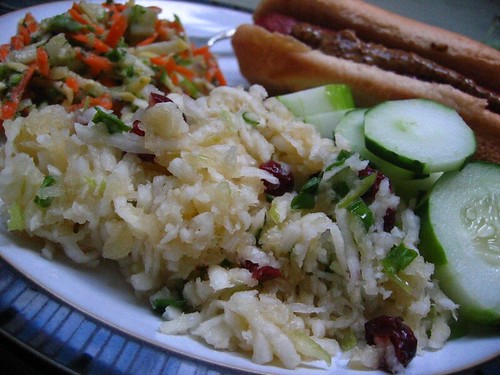
Here's where we FINALLY used up the last of the confetti salad! It seemed like a good accompaniment to a hot dog. I don't know what it is with me and hot dogs lately but I have eaten more hot dogs in the past few months that I did in the previous two decades. All of a sudden last April I got a powerful craving for hot dogs. I ignored it for a few days because I don't actually like hot dogs. Or so I thought. When I finally gave in, I was shocked - they were delicious! I think we're now on our third pack since then. These are Hebrew Nationals, which I find to be the tastiest, served on wholegrain buns with sauerkraut and mustard.

The white-ish looking salad in the foreground is my attempt at kohlrabi slaw. Kohlrabi is new for me this year. The two other times we got some in our CSA box, I cut them up and put them in stir fry. This time, I mixed shredded kohlrabi and a shredded Granny Smith apple with scallions, dried cranberries, and an attempt at a sweet-and-sour dressing involving vinegar, lemon juice, and sugar. I wasn't wowed, so I threw in some Bragg's Liquid Aminos, a super-healthy soy sauce alternative. It still didn't do much for me. Luckily Dan thought it was alright so he finished it up and I didn't have to feel bad about wasting food. I know there are a million ways to prepare kohlrabi, so I'll just have to keep trying until I find a way that I like.

Tuesday, July 29, 2008

Out of the Box, Week 7


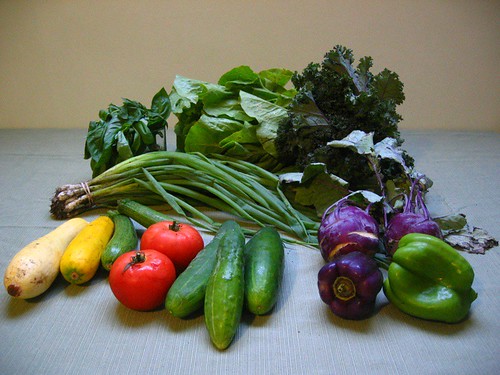
Aren't these colors glorious? We're clearly at the height of summer. It's really nice to be back home and get another huge box of veggies.

It was recently brought to my attention that some readers might be wondering just how it is we get a nice box of veggies every week. We participate in a CSA (community-supported agriculture) program. It's sort of like a subscription service for produce. We paid in advance for a full year's worth of vegetables. From June to October, we pick up a box once a week; November through May, we'll pick up a somewhat larger assortment once a month.

It's a nice deal for all involved: the farmer gets money in advance to help pay for seeds and planting, and we end up getting fresh, local, organic vegetables and herbs at a lower price than we would pay in stores or at the farmers market. Our share works out to about $10 per week over the course of the year.

Clearly, we're getting more than $10 worth of vegetables here: we've got a large head of romaine, some kale, a bunch of basil, a huge bunch of scallions, summer squash, zucchini, tomatoes, cucumbers, a green bell pepper, a purple pepper, and two kohlrabi.

We signed up for the CSA at Luna Bleu Farm in South Royalton, Vermont. To find a CSA in your area, go here.

Sunday, June 29, 2008

Out of the Box, Week 3

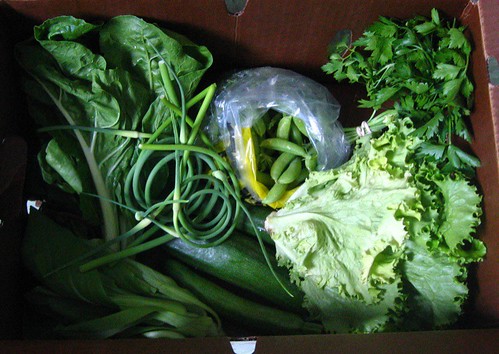
Clockwise from top left: chard, garlic scapes, sugar snap peas, parsley, lettuce, zucchini, kai-lan.

I had planned to stir-fry the kohlrabi in the middle of last week, but when I heard we might be getting some bok choy in box #3, I decided to hold off and use them together. It looks like we ended up with kai-lan instead, but that's just as good for stir-frying.

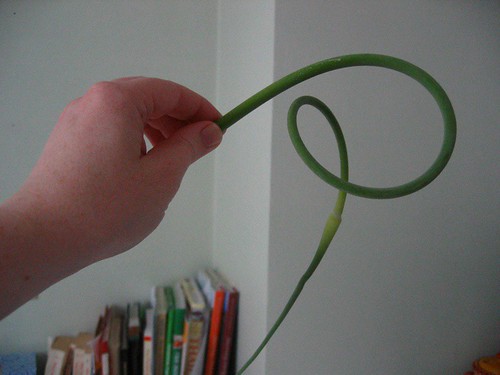
The garlic scape, like the kohlrabi, is exactly why I wanted a CSA. Not only had I never bought garlic scapes, I'd never even heard of them. I think they are strangely beautiful. If I were a floral designer, I'd be sticking these babies in arrangements whenever I could get my hands on them. Here is a nice little article about them. You can use them however you would use garlic, steam them and serve them with butter, or make pesto with them. I decided to split my share in half, using some for the stir fry and some for this spinach pesto recipe, which will also help me use up the last of that gigantic bag of spinach.

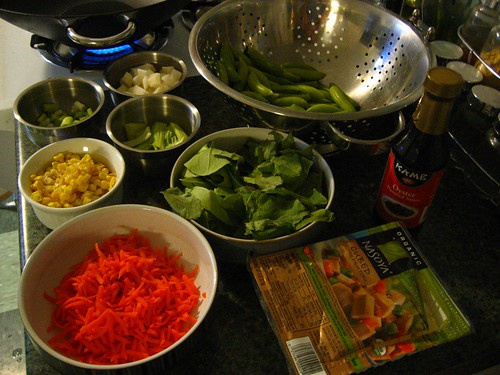
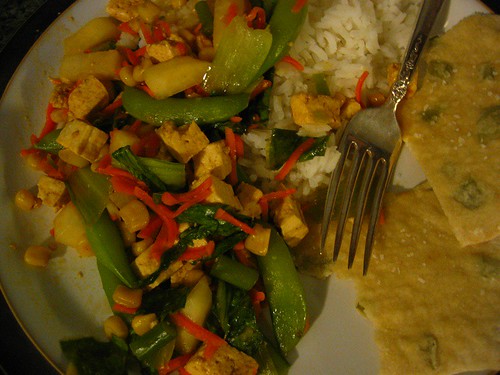
Here are all my stir-fry ingredients, ready and waiting while the fire heats the wok. In the colander are most of this week's sugar snap peas. I have cubed tofu and bottled oyster sauce, for convenience. Some frozen corn and a shredded carrot add color. The leaves are from the kohlrabi and kai-lan. In the little prep bowls, clockwise from top left, are garlic scapes and the white scallion parts, kohlrabi, and kai-lan stems.

Less than ten minutes later, dinner was ready. I had previously made scallion pancakes with the last of the bunch from week two. I used the recipe from the New Moosewood Cookbook. These were a little tough. I may have kneaded the dough too much. I baked these, instead of frying them, in a small nod to nutrition.

Overall the stir fry was tasty and I really liked that I got to use so many new vegetables in it. We had plenty left over for today's lunch, too, and even a little more for tomorrow's bentos.

Last but not least, we enjoyed a tasty glass of cheap bubbly to celebrate the fact that I am now fully self-employed!

Wednesday, June 25, 2008

tuna cakes with mystery greens and feta

Tuna is one of those things that I will buy a stack of and then realize that I don't actually like it very much. I just suddenly think "Tuna's a great idea!" and the next thing I know, I have eight cans of tuna sitting in my cupboard for two years. For these tuna cakes, I used the very last can from one such frenzy. I first came across a tuna cake recipe four years ago when we lived in London and were completely skint. I spent hours googling "cheap cooking" and "frugal recipes" and things like that, and tuna cakes was one of the meals I found. That recipe involved crushed up crackers, I think.

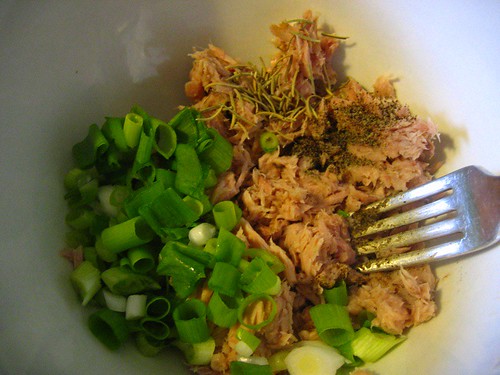
For this one, I seasoned the tuna with scallions from our CSA box, dried rosemary, pepper, and a squirt of lemon juice. Then I added a beaten egg and some bread crumbs and formed little patties, which I pan-fried in a little olive oil.

This looks like a pathetic little meal - I should have used smaller plates. It was actually pretty satisfying. I steamed some greens, which I thought were chard, but after eating them, I'm not so sure - they didn't taste quite like the chard I've had in the past. Maybe they were a different variety? I don't know. A little feta sprinkled on top helped counteract the bitterness.

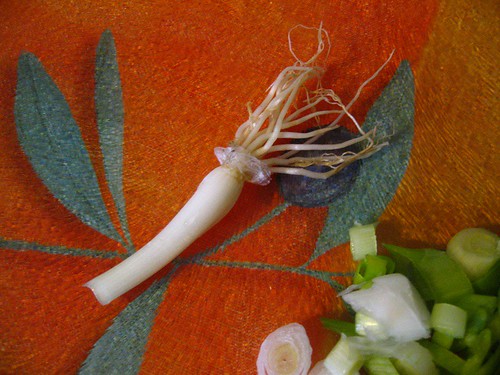
I realized while cutting up the scallions for this recipe that the root end of the scallion looks like a crazy little head. In particular, they remind me of this guy.

Not only is Pepe the coolest by far of the new generation of Muppets, he's also an excellent director.

Tuesday, June 24, 2008

by special request

Strawberry soup, because my hubby asked for it.

Just strawberries, yogurt, and orange juice blended together. Really more of a thin smoothie, served with a spoon. I made a simple salad (lettuce, carrots, apples, cheddar) and we ate while watching Goodnight Burbank.

That didn't last long.

It was a very simple meal, but Dan loved it. It's nice that he's so easy to please.

Monday, June 23, 2008

spinach and white bean soup


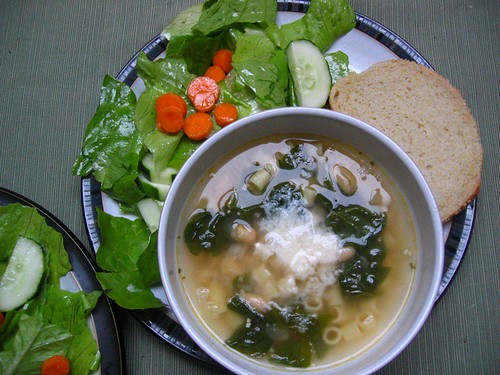
After so much time steaming spinach yesterday, I needed something really easy for dinner. Spinach and white bean soup took about fifteen minutes to cook, during which time I prepped the salad. I just sauteed some onions and garlic in a little olive oil, then added a can of vegetable stock (all I had on hand), some water, and a little low-sodium chicken bouillon, as well as a cup of ditalini and a can of cannellini. Once the pasta was tender, I stirred in some spinach, just until it wilted, then served it up with a little grated asiago. Delicious and satisfying!

Sunday, June 22, 2008

Out of the Box, Week 2


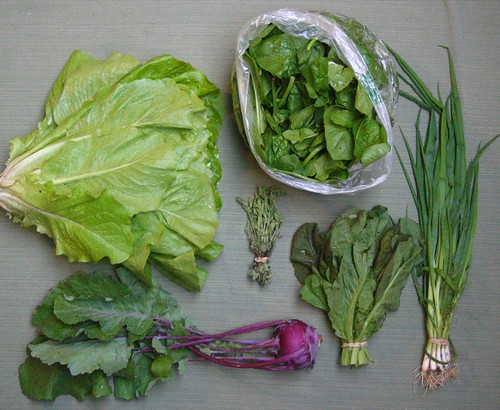
Clockwise from top left: lettuce, spinach, scallions, unidentified leafy bunch, oregano, kohlrabi.

This week brought a lot of greens, which is to be expected, and a vegetable that I had never tried before: kohlrabi. This is exactly why I signed up for a CSA; I wanted to be forced to try things that I wouldn't normally choose. I've seen kohlrabi in the supermarket before, but I wouldn't have been able to tell you what it was. It looks like a mutant radish from outer space. I'm definitely excited to try it out.

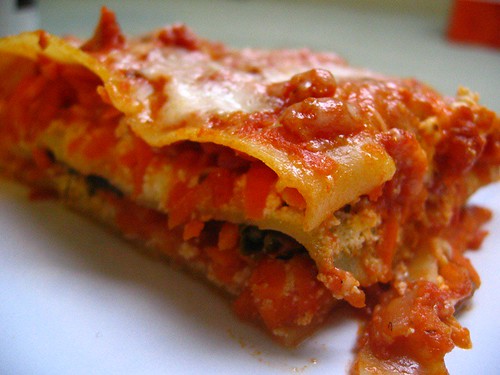
First, however, we still had spinach left over from week 1, and now we have more! This bag of spinach doesn't look that big, but it's tightly packed - about as heavy as a basketball. I couldn't even begin to think what to do with it all, so I used what was left to make a veggie lasagna.

This is kind of a skinny/flat lasagna - I only had the spinach, which I steamed first, and carrots, which I shredded. Normally I like to add mushrooms, too, but I didn't have any on hand. With some low-fat ricotta and mozzarella, leftover jar sauce, and no-boil lasagna sheets, this was a quick and easy meal, rounded out with sliced cucumbers and some homemade garlic bread. It was so satisfying that I decided veggie lasagna would be a good solution to the spinach problem.

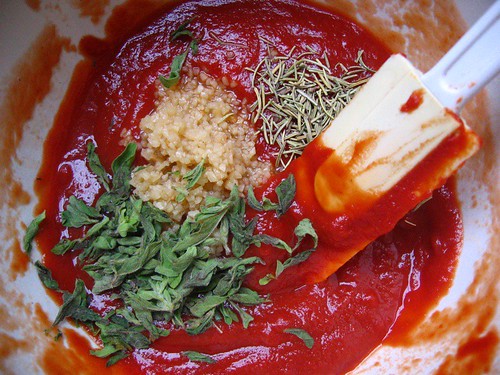
I spent most of today steaming a good portion of this week's spinach and layering a huge veggie lasagna (with mushrooms, this time). I didn't have any sauce on hand, so I made some, based loosely on Rebecca Blood's no-cook pizza sauce. I used the oregano from the CSA box, as well as some garlic and dried rosemary, tomato paste, water, and a big can of diced tomatoes.

I froze the entire lasagna (cutting it up and wrapping each piece individually), so that will be nice at some point later on when I just don't feel like cooking.

Wednesday, June 18, 2008

salad, take two

Now this salad, while similar to the last one, was much more satisfying. In fact, it was downright hearty. I was so stuffed that I didn't even eat dessert (a VERY RARE occurrence).

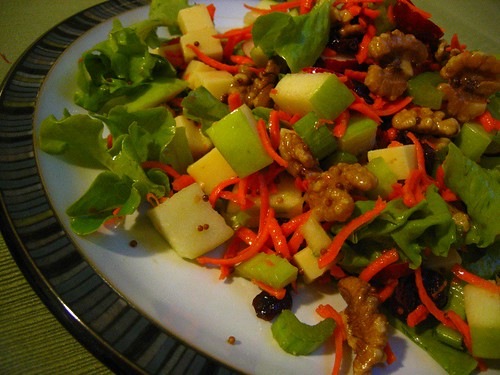
I used the enormous mutant lettuce as a base, and topped it with celery, carrots, Granny Smith apples, cheddar cheese, dried cranberries, and walnuts. It's dressed with my mustard vinaigrette, as usual. This time I shredded the carrots using our Salad Shooter. It's one of those weird little gadgets that I probably wouldn't have purchased on my own, but we received one as a gift from my sister-in-law and it has turned out to be one of the best gifts I've ever received. It's amazingly fast and easy, and I use it constantly. It takes so much of the work out of the whole shredding process - my grater is pretty much obsolete at this point.Post Options

Tuesday, June 17, 2008


Here's the first of many salads that we will eat this week. I used some of the colossal lettuce as well as some mixed greens (baby spinach, mustard, arugula, and several more that I can't identify). This night, I was craving all things crunchy, so I loaded up on celery, carrots, radishes, cucumbers, and sunflower seeds. I used my basic mustard vinaigrette (salt, dried mustard, champagne vinegar, and olive oil) that I put on almost all salads.

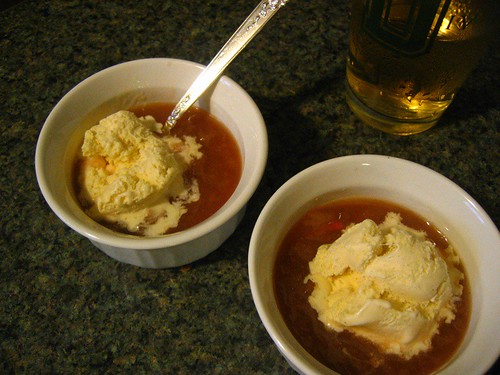
It was a tasty salad, but not quite filling enough. Thankfully, we had the rhubarb for a delicious dessert. I used Phat Duck's compote recipe, made with orange liqueur, and it was fantastic! The liqueur and the touch of butter really enhanced the natural flavor of the rhubarb. It was a little sweet for my liking, though, so next time I would cut the sugar down to a scant half a cup.


When I have rhubarb, I pretty much do a compote (with or without strawberries) or sometimes a crisp. My grandmother makes wonderful strawberry-rhubarb pies. But I'd like to do something different with it - do you have any suggestions for unusual rhubarb recipes? If so, please post in the comments! I'd love some new ideas.

By the way, that nice cold glass you see in the corner of the compote photo is spiced rum and ginger beer, a favorite drink of mine for summer (so refreshing!).

Sunday, June 15, 2008

Out of the Box, Week 1


I've wanted to sign up for a CSA for a few years, but we've been thwarted by life events (one year hoping we would move out of state, then the next year knowing we would). Finally secure in the knowledge that we'd be in one place for a whole growing season, we signed up for a weekly small share from Luna Bleu Farm.

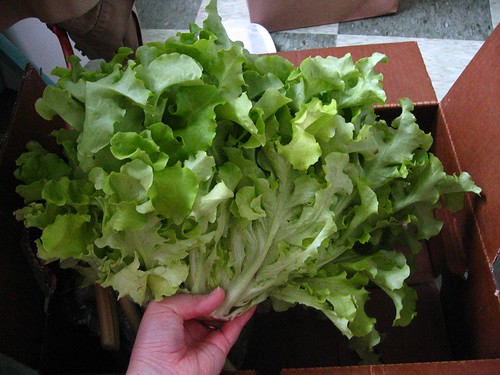
Not surprisingly, this early in the season, we get A LOT of greens. Take, for instance, this mega head of lettuce.

I think the fact that I have giant man-hands is throwing off the perspective of this picture. This lettuce was seriously HUGE - it must have been 18 inches across. It took a few hours to clean and spin the whole thing.

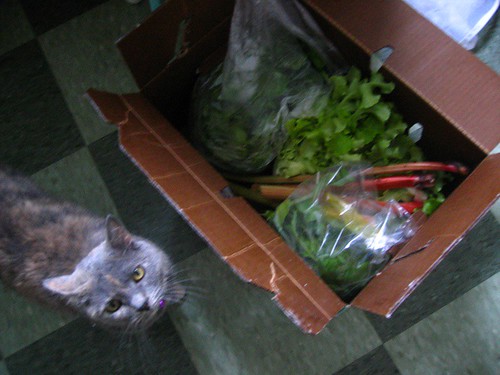
In addition to the colossal lettuce, we received a good-sized bag of spinach, a bag of mixed greens, and a handful of rhubarb spears. Clearly, the first week of eating out of the box would entail many salads. Pictures and details of just what we did with all those leaves to come in future posts.